

Not every purchase is an investment. That sounds obvious, but in the modern digital world, it’s surprisingly easy to forget and down the drain goes smart spending. Every day, people are surrounded by ads promising productivity, efficiency, entertainment, or status. A new device launches. A new gadget is trending on social media. A new upgrade appears that promises or seems to make life “better.” And suddenly, the checkout button looks very tempting.
I saw a post on LinkedIn recently comparing a cow to an iPhone, before you squint — hear me out.
A cow and an iPhone 16 Pro both cost roughly $1,300.
The cow produces milk, offspring, and long-term value.
The iPhone produces notifications, blue light, and immediate depreciation.
At first glance, it sounds like a joke.
But hidden inside that joke is a surprisingly powerful way to think about spending. Especially for individuals working in tech, development, marketing, and other digital industries.
But hey, long-term value can be a matter of perspective.
The Problem With Modern Spending
Technology has made purchasing incredibly easy, a few taps on a screen, and the product is already on its way. But the convenience has created a new problem: people rarely stop to ask whether a purchase actually improves their long-term productivity or financial position.
Many purchases fall into what could be called the “shiny object trap.”
The product looks impressive.
It feels exciting to own.
But six months later, it adds little real value.
This is not limited to phones.
It applies to many types of purchases:
- unnecessary gadgets
- software subscriptions that are never used
- hardware upgrades that provide no measurable improvement
- tools bought because they look impressive rather than useful
In many cases, these purchases are not tools.
They are toys.
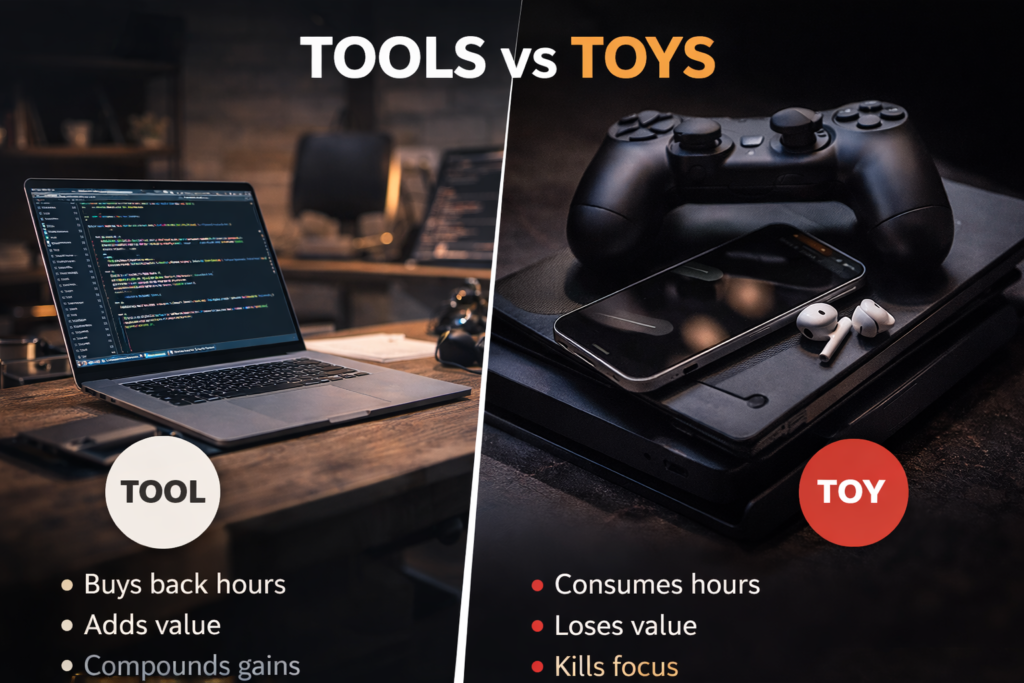
The Tool vs The Toy
One simple way to evaluate purchases is by asking a very practical question:
Is this a tool, or is it a toy?
A toy is something that mainly consumes time, money, or attention.
A tool, on the other hand, helps produce value.
Tools usually do one or more of the following:
- increase productivity
- reduce time spent on repetitive tasks
- improve the quality of work
- create opportunities for higher income
In other words, tools tend to multiply capability.
Toys tend to multiply distractions.
This doesn’t mean entertainment has no place in life. Everyone needs rest and recreation — this life no hard!
But the problem arises when resources are spent primarily on things that do not generate meaningful returns.
This is where the cow comparison becomes interesting.
The “Calf Test”
The cow in the comparison represents something that creates more value over time.
It produces milk.
It can produce offspring.
It continues generating benefits long after the initial purchase.
The iPhone, while useful, does not generate additional value on its own. Like I said earlier, “long-term value can be a matter of perspective”.
Regardless, the iPhone gradually loses value as new models appear.
So the real idea behind the comparison is not about cows or smartphones.
It is about a simple mental filter:
Does this purchase have a “calf”?
In other words:
Will it produce more value in the future?
If the answer is yes, it is likely an investment. If the answer is no, it may simply be an expense. By doing this, you have followed the golden rule of smart spending.
Why This Matters in the Digital Economy
For individuals working online, the difference between tools and toys is even more important. In the digital economy, where efficiency, skill development, and leverage are rewarded, the right tools can dramatically increase productivity.
Consider these examples:
- A developer who invests in a powerful workstation may cut build times in half.
- A marketer who invests in automation tools might save several hours each week.
- A freelancer who purchases a specialised course may gain the expertise needed to charge significantly higher project rates.
In these situations, the purchase does more than simply exist; it expands capability.
That is the modern version of buying a cow, buying leverage and spending smart
Automation
One of the most valuable investments you can make today is automation.
Many digital tasks are repetitive:
- sending routine emails
- managing social media scheduling
- organizing data
- updating reports
- performing repetitive technical checks
Automation tools can handle these tasks with minimal human input.
The result is simple but powerful: time is returned. In an age where we all try to get involved with so many things at the same time — time is of the essence.
And time, unlike money, is the one resource that cannot be replenished.
A tool that saves five hours every week may end up saving more than 250 hours per year.
That is the equivalent of more than six full workweeks.
Suddenly, the price of the software looks very different.
Upskill Instead of Upgrading & Aesthetics
Another powerful investment is education. For some, education might immediately make you think of school. But this is not necessarily the case.
Education is simply the process of learning (acquiring knowledge) for understanding or to acquire a particular skill.
Many people instinctively upgrade their devices whenever a new model appears. But in many cases, upgrading hardware produces only marginal improvements.
Learning a new skill, however, can transform an entire career. A specialised certification might allow someone to enter a new market, and a deeper understanding of a technical framework may unlock more complex projects.
A new capability can dramatically increase professional value, and unlike gadgets, skills do not depreciate the moment the box is opened.
They compound.
The Long-Term Strategy
The “cow vs iPhone” idea is not about rejecting technology or avoiding modern tools.
In fact, smartphones, laptops, and digital platforms are essential in today’s world.
The real lesson is about priority.
Instead of buying status or unnecessary upgrades, focus on things that generate long-term value, and spend smart.
Automation tools.
Skill development.
Reliable systems.
These are the cows.
Once those investments begin producing results, purchasing other items becomes much easier.
Because the tools begin paying for everything else.
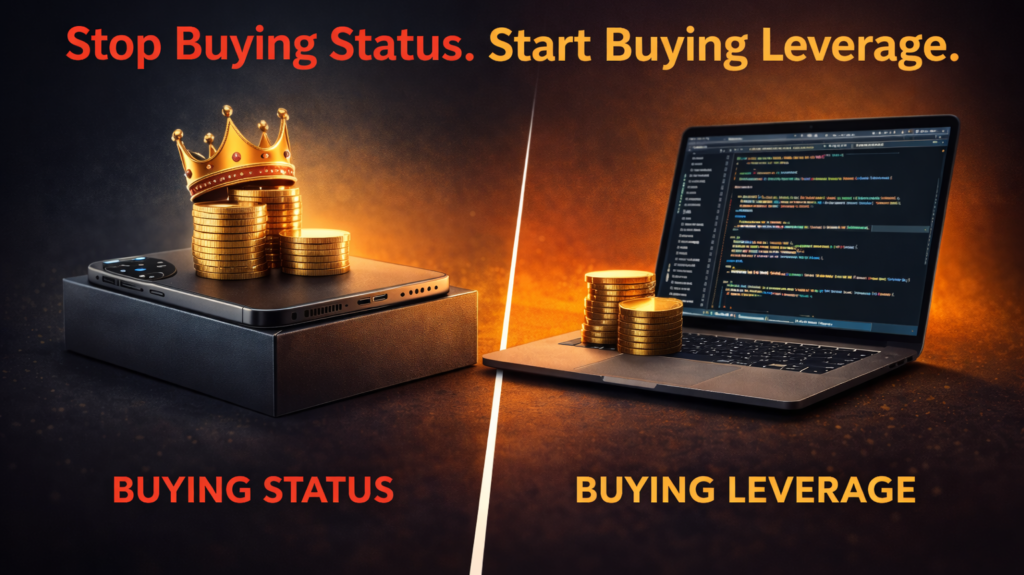
Buy the Cow First
The modern economy rewards people who think in terms of compounding value. The more tools someone has that multiply their productivity, the more opportunities they create for themselves.
This process does not happen overnight, but over time, the results become clear.
Better systems lead to better work.
Better work leads to better opportunities.
And better opportunities lead to greater freedom in what someone chooses to buy.
Which brings the entire idea back to the original comparison.
The goal is not to avoid buying the iPhone.
The goal is much simpler.
Buy the cow first.
Then let the calf pay for the iPhone later.