
A good website redesign should not be about making your website look newer just for its own sake. It should improve how the website works, how visitors experience it, and how effectively it supports your business goals.
Your website may look fine to you because you see it every day. But your visitors are not looking at it with the same eyes.
If your website is slow, difficult to use, confusing, outdated, or failing to generate inquiries, the problem may be bigger than changing a few colors or replacing some images.
Sometimes, the website simply needs a redesign.
Here are 10 signs that it may be time to rethink your website.
1. Your Website Looks Outdated
Design trends change, but this is not just about whether your website uses the latest colours or animations.
An outdated website can make your business appear less trustworthy.
For example, your website may have:
- Old-looking layouts
- Poor typography
- Too much text is packed together
- Low-quality images
- Inconsistent colours and spacing
- Cluttered navigation
- Buttons that are difficult to notice
- A design that looks very different from your current brand
Your website does not need to follow every design trend.
It simply needs to look professional, clear, and appropriate for the people you want to attract.
If visitors immediately feel that your website belongs to another era, it may be time for a redesign.
2. Your Website Is Difficult to Use on Mobile
This is one of the biggest reasons to consider a website redesign.
A website can look perfectly fine on a desktop computer while being frustrating on a phone.
Check your website on an actual mobile device.
Can visitors read the text without zooming?
Can they easily tap your buttons?
Can they find your menu?
Can they complete your contact form?
Do images or sections extend beyond the screen?
If visitors have to pinch, zoom, scroll sideways, or fight with your navigation, your website needs attention.
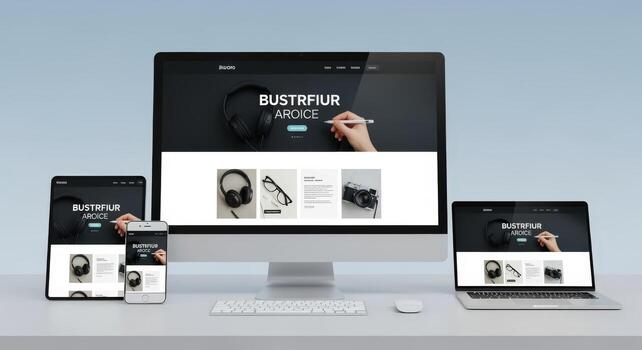
A responsive website should adapt naturally to different screen sizes.
Mobile usability is especially important because many people will encounter your business through a phone before they ever use a laptop.
3. Your Website Takes Too Long to Load
People are not particularly patient online.
If your website takes too long to become usable, some visitors will leave before they even see what you offer.
Slow performance can be caused by many things, including:
- Large images
- Too many plugins
- Unoptimized JavaScript and CSS
- Poor hosting
- Unnecessary third-party scripts
- Bloated themes or page builders
- Poorly optimized media
Before deciding that you need a complete redesign, test your website performance.
Sometimes optimization can solve the problem without rebuilding the entire website.
But if poor performance is caused by an outdated structure, theme, or technical setup, a redesign may be the better long-term solution.
4. Visitors Cannot Quickly Understand What You Do
Imagine someone landing on your homepage for the first time.
Within a few seconds, can they answer three questions?
What do you do?
Who do you help?
What should I do next?
If the answer is no, your website may have a messaging and structure problem.
Your homepage should not force visitors to investigate your entire website before they understand your business.
Your main message should be clear.
Your services should be easy to find.
And your most important action should be obvious.
That action could be booking a consultation, requesting a quote, buying a product, calling your business, or contacting you.
A redesign gives you an opportunity to simplify the entire user journey.
5. Your Website Gets Visitors but Few Enquiries
This is an important distinction.
If people are visiting your website but very few are taking action, the problem may not be traffic. It could be conversion.
Look at your website from the perspective of a potential customer.
Is it obvious what you offer?
Are your calls to action clear?
Is there enough information to build trust?
Are your forms unnecessarily complicated?
Are your contact details easy to find?
Does each important page provide visitors with a clear next step?
Your website should not simply attract visitors.
It should help the right visitors take action.
If you already have traffic but very few leads, improving your website structure and conversion paths may be more useful than simply trying to generate more traffic.
6. Your Website Is Difficult to Update
A website should not require a developer every time you want to change a phone number, update a service, publish an article, or replace an image.
If your current website is difficult to manage, you may be spending unnecessary time and money maintaining it.
This is especially frustrating for small businesses.
Your website should make routine changes reasonably simple.
A redesign can be an opportunity to improve both the backend and the front end.
That might mean moving to a better content management system, cleaning up the website structure, simplifying templates, or creating reusable sections.
The goal is not simply to make the website easier for visitors.
It should also be easier for your team to manage.
7. Your Website No Longer Reflects Your Business
Businesses change.
You may have added new services, changed your target audience, updated your branding, or moved into a completely different market.
But your website may still be communicating what your business used to be.
For example, your website might still:
- Promote services you no longer offer
- Use an old logo
- Target the wrong audience
- Show outdated pricing
- Feature old team members
- Use messaging that no longer represents your business
When your business changes significantly, your website should change with it.
Otherwise, potential customers may receive the wrong impression before they ever speak to you.
8. Your Website Has SEO Problems
A redesign can also become necessary when your website has structural SEO problems that are difficult to fix individually.
Examples include poor site architecture, confusing navigation, weak internal linking, duplicate pages, outdated content, or technical issues that have accumulated over time.
However, there is an important warning here.
Do not redesign a website without considering its existing SEO value.
Your current website may already have pages that rank, attract visitors, earn backlinks, or generate leads.
Before rebuilding, identify what is already working.
Record important URLs, traffic, rankings, conversions, and valuable content.
If URLs change during the redesign, plan appropriate redirects. Also, make sure important content and internal links are not accidentally removed.
A redesign should improve your website, not erase the SEO work you have already done.
9. Your Competitors Have Clearly Moved Ahead
You should not redesign your website simply because a competitor changed theirs.
But if competing businesses consistently offer a clearer, faster, easier experience, it is worth paying attention.
Visit several competitor websites and compare:
- Navigation
- Service pages
- Mobile experience
- Calls to action
- Page speed
- Content
- Contact process
- Overall clarity
The goal is not to copy them.
It is to identify where your own website is making things harder for potential customers.
Sometimes the gap will reveal exactly what needs to change.
10. Your Website Was Built Around a Problem That No Longer Exists
This one is easy to overlook.
Your website may have been built five years ago around the tools, content, business model, and audience you had at the time.
Since then, everything may have changed.
Adding another plugin or creating another page may no longer solve the underlying problem.
You may need to rethink the structure itself.
That is when a redesign becomes more valuable than continuously patching the existing website.
Should You Redesign or Just Improve Your Website?
Not every website needs a complete rebuild.
Sometimes the problem can be solved with targeted improvements.
For example:
Improve instead of redesigning if:
- Your website structure is still good
- Your branding still fits your business
- Your website works well on mobile
- Your main pages perform reasonably well
- The problems are limited to speed, content, or a few design issues
Consider a redesign if:
- The entire website feels outdated
- Mobile usability is poor
- Navigation is confusing
- Your website no longer reflects your business
- The underlying technology is limiting you
- Visitors struggle to understand your offer
- The website consistently fails to generate enquiries
The right decision depends on what is actually causing the problem.
Before You Redesign Your Website
Do not start by choosing a new colour palette.
Start with an audit.
Look at your current website and identify:
- What is working?
- What is not working?
- Which pages receive the most traffic?
- Which pages generate enquiries?
- Which pages rank in search?
- Where do visitors drop off?
- Which pages need to be improved, merged, or removed?
- What does your new website need to achieve?
This gives you a much better starting point than simply saying, “I want a new website.”
A successful redesign should have a reason behind it.
Final Thoughts
Your website does not need to be redesigned simply because it looks a little old.
The bigger question is whether it is still doing its job.
If your website is difficult to use, slow, confusing, poorly optimized for mobile, disconnected from your current business, or failing to turn visitors into enquiries, those are stronger reasons to take action.
And sometimes the answer is not a complete redesign.
It may simply be better content, better structure, faster page load times, clearer calls to action, or technical cleanup.
Start by finding the real problem.
Then fix the website around that problem.
That is how a redesign becomes more than a fresh coat of paint. It improves the way your business works online.